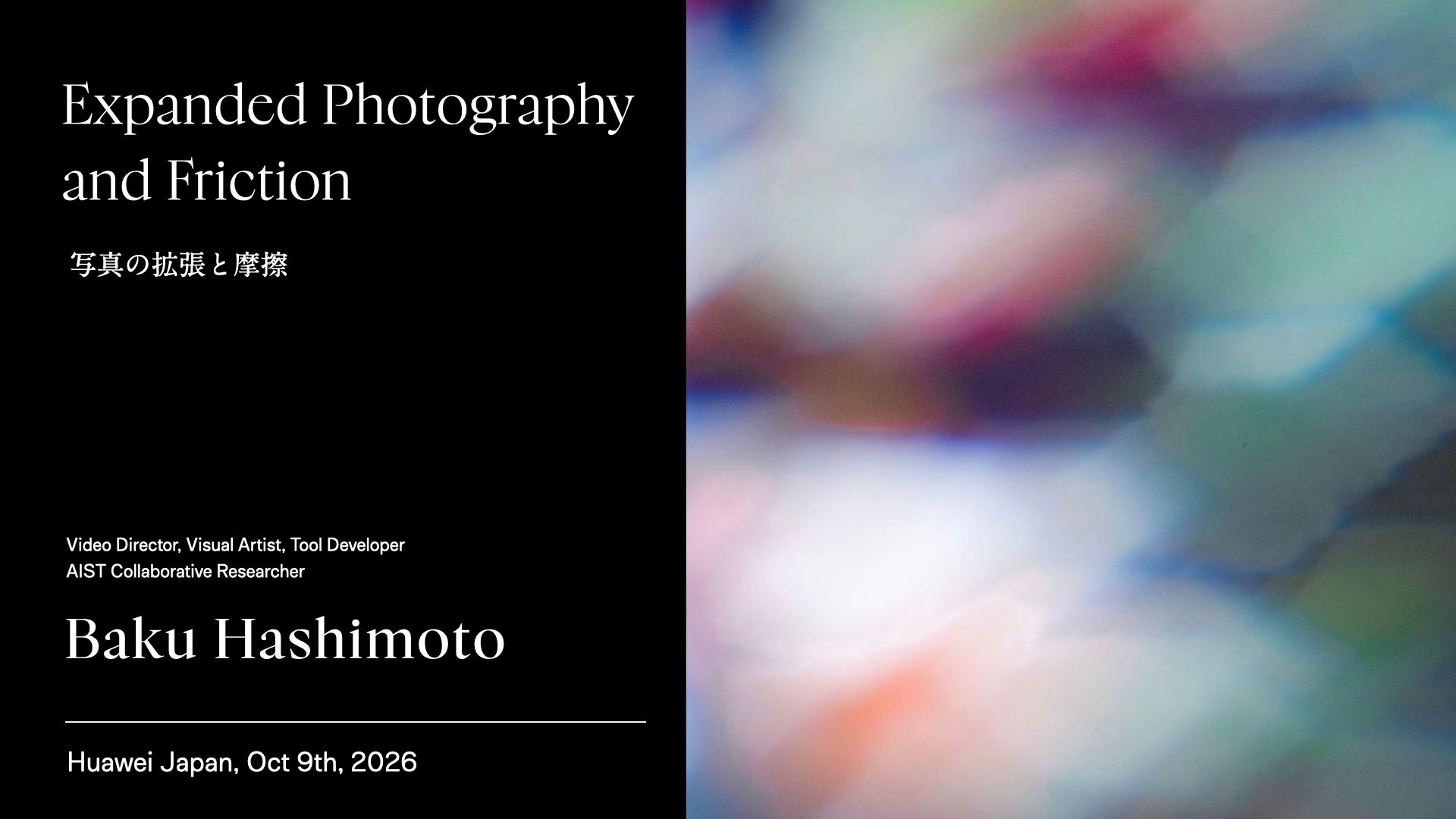
Huawei Talk: #3 Expanded Photography and Friction
I gave a talk for in-house CG researchers and product designers at Huawei Japan. This was a joint session with Akihiko Taniguchi, and my part served as an opening act leading into his talk on in-game photography and machinima.
Language: Japanese (with simultaneous interpretation in Mandarin and English)
Photographic technology has developed toward results you can see at once and a look you can readjust afterwards. RAW development, light-field cameras, 360-degree cameras, NeRF and 3D Gaussian Splatting defer decisions on parameters such as exposure, focus, framing and viewpoint until after the shot. Yet the history of photography also includes artists who bring friction into their practice, deliberately choosing not to be fully in control, or not to be able to go back: lag, irreversibility, destructive editing, shooting without the viewfinder. This talk considers that paradox while tracing artists who have expanded the ways of taking a photograph, from Man Ray's rayographs to Thomas Ruff, Kenta Cobayashi and Taro Karibe.
Takeaways
- Photography has been expanded by taking things away.
- Deferring a parameter does not remove the decision.
- Friction can be worth designing in.
Keywords, Figures
- ふたたびくみたてる 日本の新進作家 vol.23 / Assembling Anew: Contemporary Japanese Photography vol. 23(東京都写真美術館)
- Photo-graphy / 光画 / 写真 / 撮影
- Vilém Flusser, Towards a Philosophy of Photography (『写真の哲学のために』)
- Expansion of Photography
- No-finder: Daido Moriyama, Takuma Nakahira / Provoke, アレ・ブレ・ボケ
- Old lenses, projector lenses
- Man Ray, Rayographs
- Wolfgang Tillmans, Freischwimmer
- Thomas Ruff, Photograms, jpeg
- Nerhol / Slit-scan photography
- Taro Karibe, あの海に見える岩を、弓で射よ / "cognitography" / latent image
- Artie Vierkant, Image Objects
- Kenta Cobayashi (小林健太), #smudge
ラグができて、軌跡を見ながら次の動きを決めていると、数秒前の自分と対話しているような気分になるんです。
テレ朝POST「小林健太インタビュー」
- Deferring Parameter Decisions
- RAW development → white balance, exposure
- Light-field camera (Lytro) → focus
- 360° camera → framing
- iOS Live Photo → the moment
- Depth sensor → depth of field
- NeRF / 3DGS → camera position
- The jam experiment
- Friction
- Destructive editing / Lag, latency / Chance operation
- Human-in-the-loop
- In-game photography → Akihiko Taniguchi, What does In-game Photography Capture?