Extending the slit-scan techniquegrass
This is a semi-public garden page — a draft, left open on purpose.
NEWREEL のインタビューで「スリットスキャンというテクニックにしたって、まだまだ全然出尽くしてない」なんて偉そうなことを言っていたので、以前から考えていた手法を半日かけて試しました。スリットスキャンらしさってのは一見あまりないんだけど、れっきとしたスリットスキャン。
どのようにスリットスキャンするとどういう画が出力されるのかをイメージするのって案外難しくて。だからこの手法は「時間をどう前後させるか?」ではなくて「映像の 1 コマ 1 コマを積層させて出来上がった金太郎飴を、どのような断面でカットしていくか?」と考えると分かりやすいです。
金太郎飴を垂直にサクサク薄切りしていくと、その断面は普通に映像を再生したように変化します。斜め切りすると、いわゆるスリットスキャン。そう考えると、当てる包丁の形は別に真っ直ぐじゃなくて良いわけです。ギザギザでも何でも。
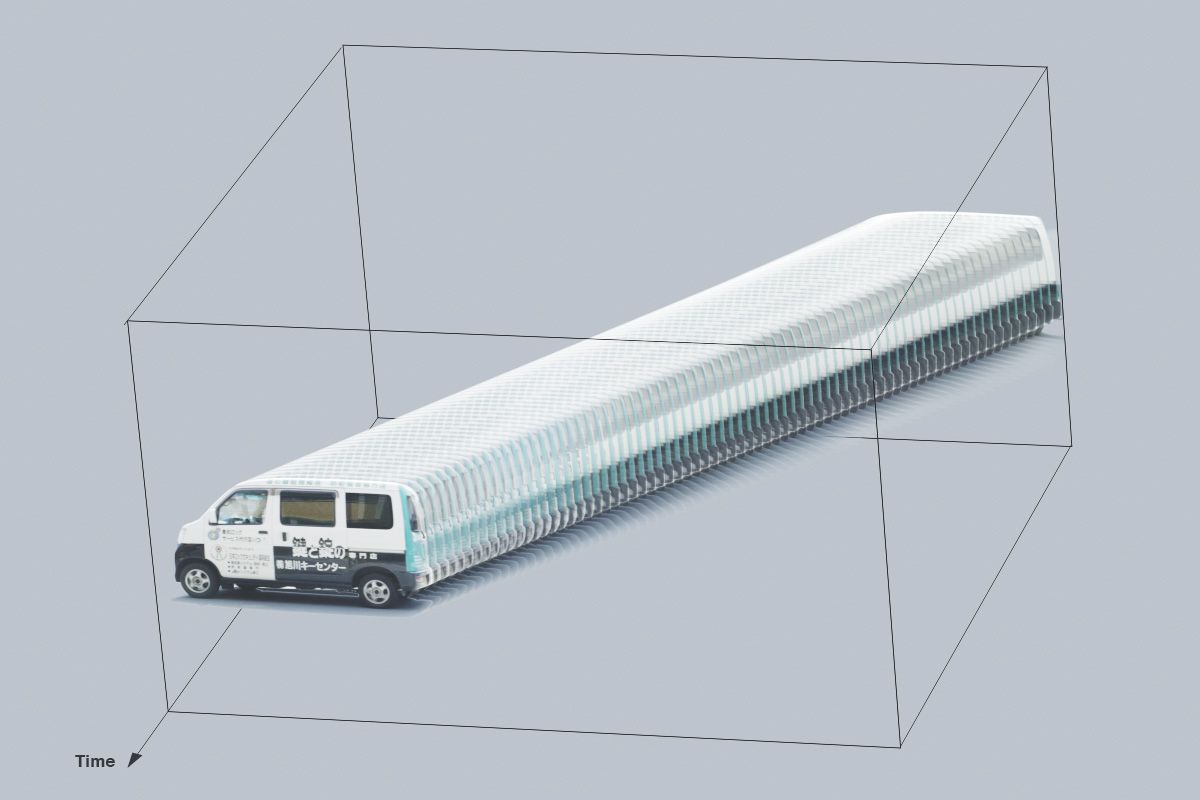
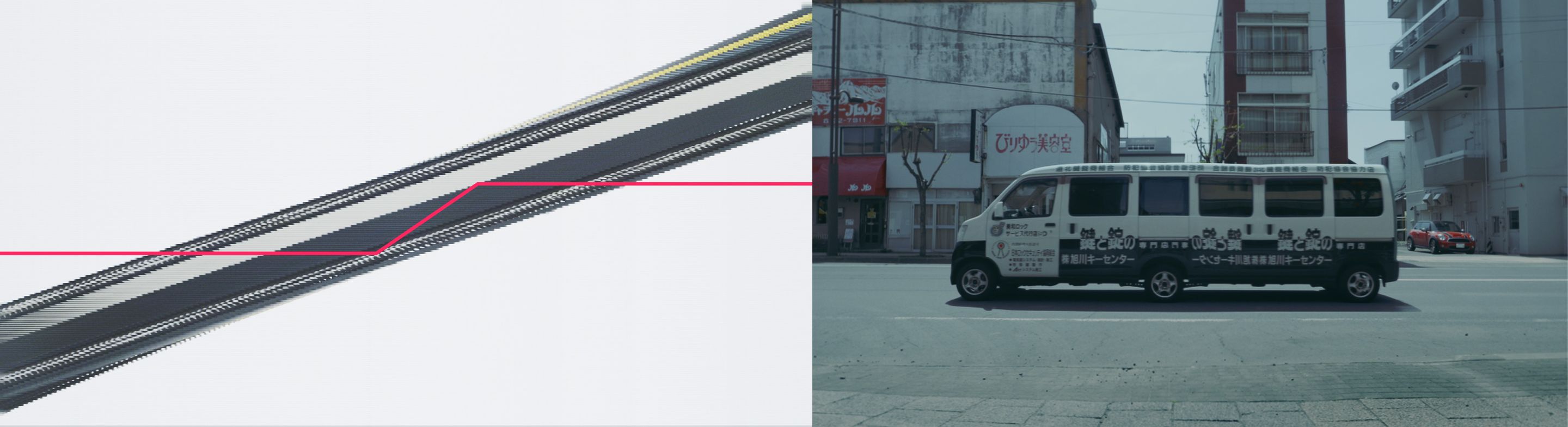
今回の動画の例でいうと、右から左へ移動する車はこんな金太郎飴をしています。
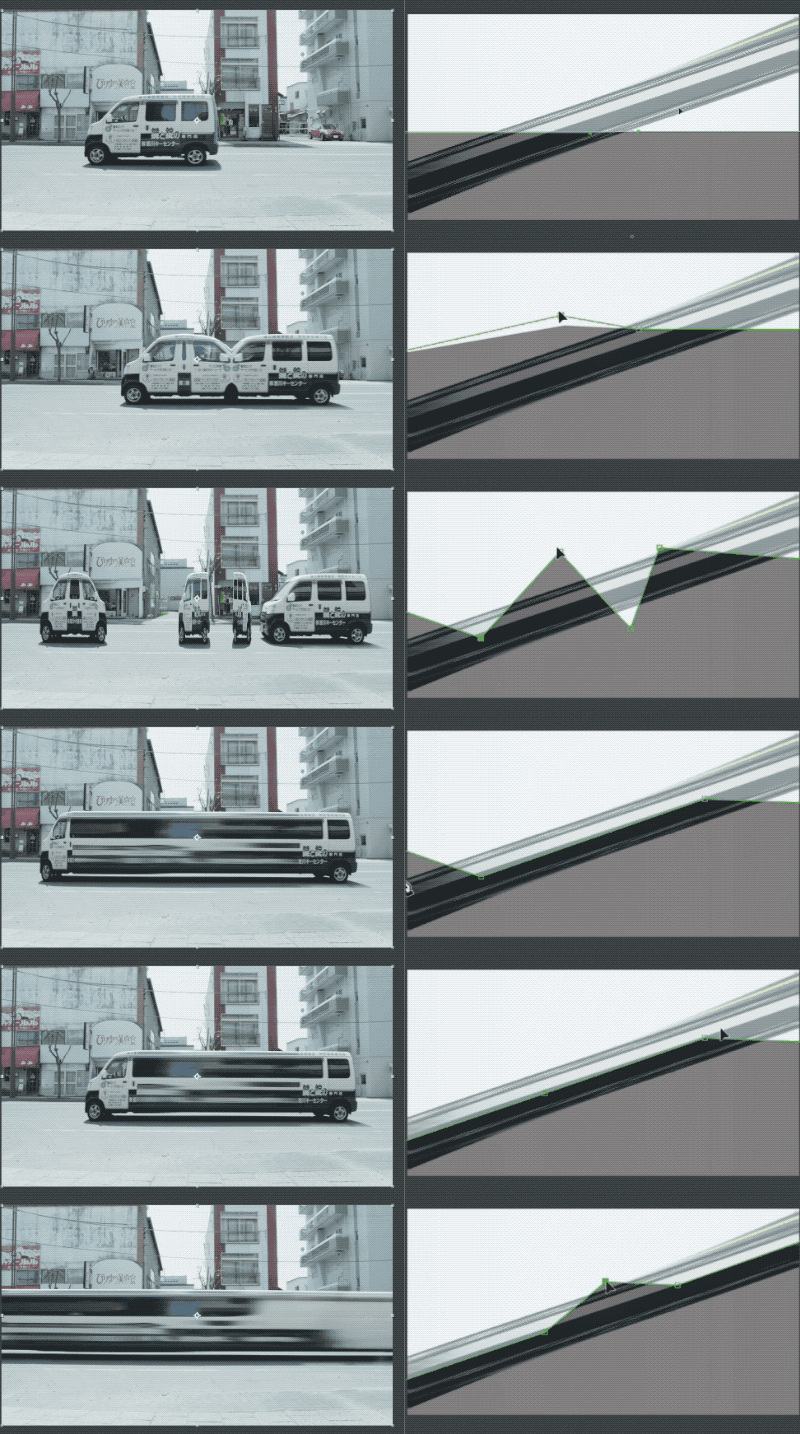
これを、こういう風に切ると短くなります。
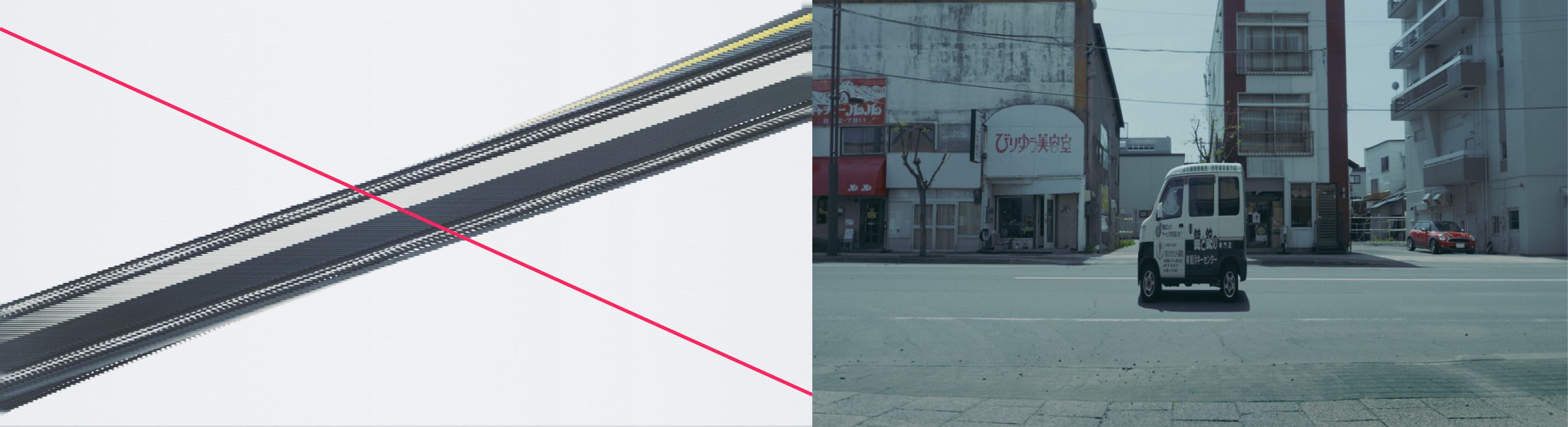
こういう風にジグザグに切ると、車両の真ん中だけを伸ばせます。
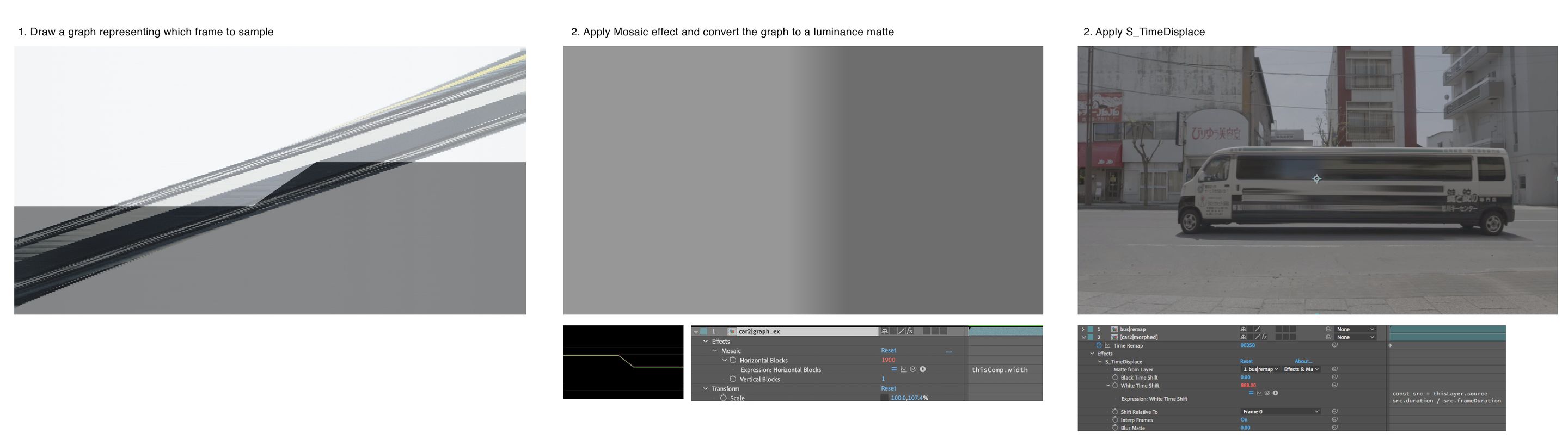
AfterEffects で作る場合、S_TimeDisplaceがかなり使えます。黒をフレーム 0、白を最後フレームとしたマットをリファレンスに出来るので。標準エフェクトだと、現在のフレームを起点とした相対量でしかスリットスキャンできないので。
ちなみに、こういうことです。
個人的にはスリットスキャンという名前が適切でないような気がしています。この手法は、映像の金太郎飴の断面を、時間軸方向に変位させていくという意味でタイム・ディスプレイスメントと呼んだほうが良いです。After Effects にも同名のエフェクトがありますし。タイム・ディスプレイスメントのうち、断面が平面なものがスリットスキャンです。断面を静止画として使っても良いですし、移動させながらサクサク薄切りすると動画になります。
この捉え方で、スリットスキャンっぽい作品を見ると、なるほどこれはこういう断面で切ったもんなんだなーと、より理解が深まると思います。これは学生時代に、常磐線の車窓から撮った映像をスリットスキャンしてパノラマにしたものです。Adam Magyar のパクリですが、移動しているのは視点の方。
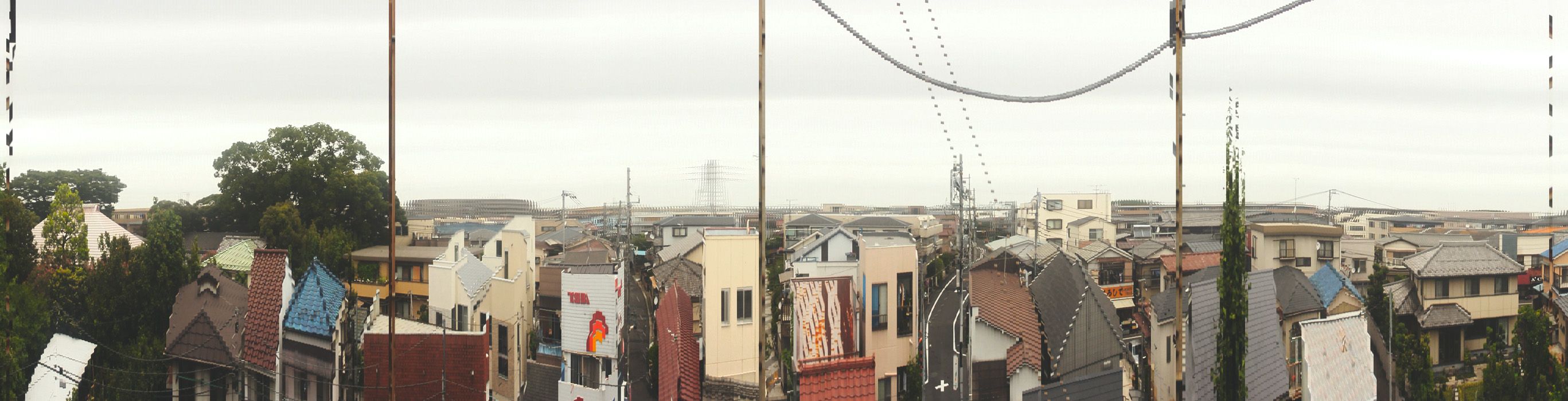
パースが、水平方向には平行投影図法、垂直方向には透視法になっているのが面白い
最近だと、好きな映像作家の Páraic Mc Gloughlin や Hiroshi Kondo さんビデオも。
今回の車が短くなるのは、Dirk Koy 氏のビデオを参考にしました。ソースの FPS が低いとこういう風にジャギるんだけど、それを逆手に取っているのが面白い。
数年前流行った Inception っぽい風景画像も、ドローンを使ったスリットスキャン。
と思ってチュートリアルを調べたら、俯瞰具合を変えて何枚か撮った写真を無理やりつなぎ合わせて作る方法がなぜか多かったです。飛行軌道のブレが問題なのか分からないけど、タイム・ディスプレイスメント使えばいいのに。
素材にしたって、溶けていく氷のタイムラプスといった「経年変化」系のフッテージを使っても面白くなりそう。とにかくこの手法はまだまだ掘りようがあるので、そういう制作があれば誘ってください。
関連記事
header
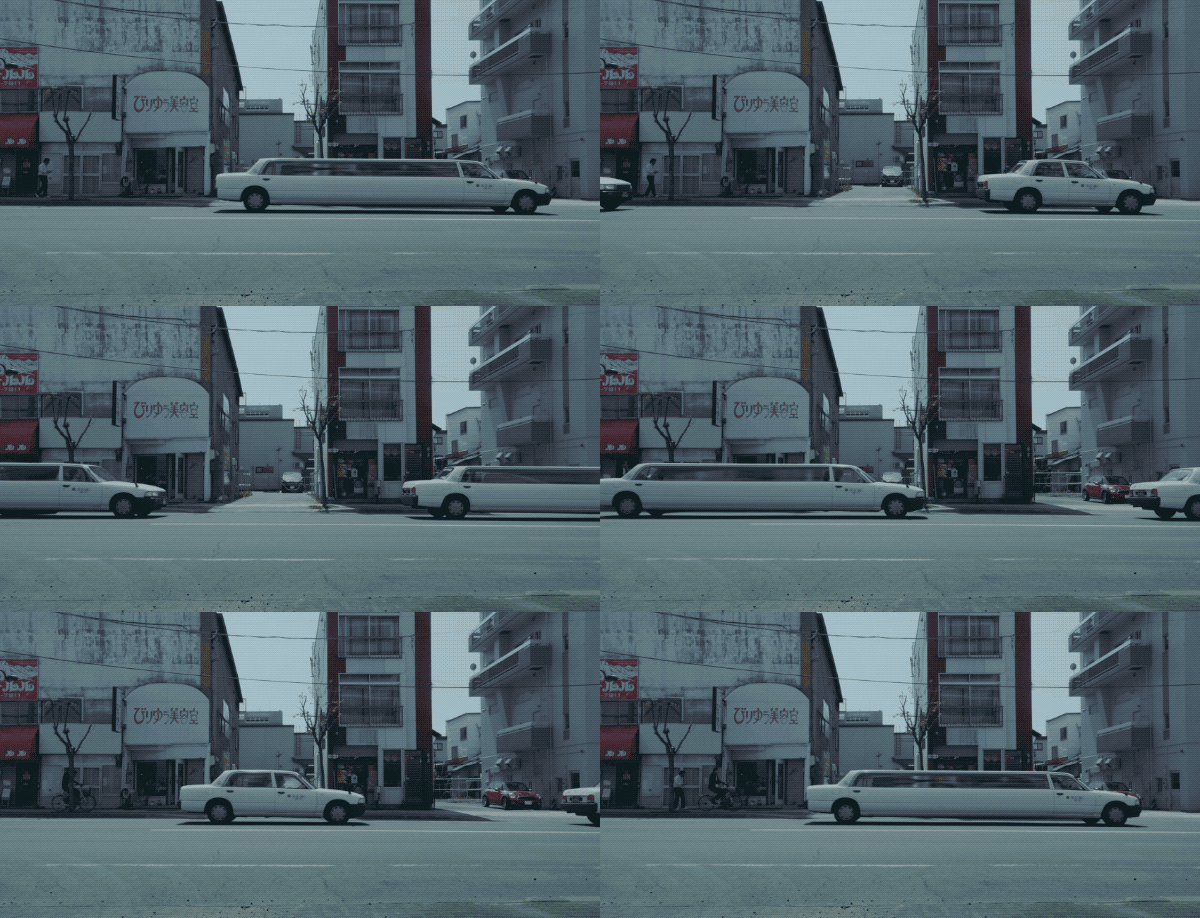
Once I said that there is still a bunch of applications when it comes to slit-scan in my interview. Thus I created this to prove it. It doesn’t look like slit-scan at a glance, though, I certainly used the technique.
It is often difficult to imagine a rendered image when you applied slit-scan to footage in some way. But I have a nice analogy to understand slit-scan. Imagine there’s a quite thick flipbook that all frames of a video are bound page by page. If you just rifle through it, the original video will be just played. Slit-scan intrinsically means slicing the flipbook diagonally.
In the top video, the flipbook of the car traversing right-to-left looks like below:
If you slice the flipbook like this, the car would shrink.
The cross-section doesn’t need to be planar. The only middle part of the car gets longer when you slice it in zigzags like this:
To create this effect in After Effects, S_TimeDisplace by GenArts was so useful since it can interpret b/w matte to map black pixel to the first frame of video and white pixel to the last frame. After Effects’ built-in Time Displacement effect only allows to time-remap each pixel relative to the current time.
Here is the additional screenshot to recreate the composition in AE:
I think the name of “slit-scan” makes people confused. It’s rather appropriate to call it “time displacement” just like the name of AE’s effect because this technique actually means displacing a cross-section of “world volume” (like a flipbook, it is an imaginary 3D cube consists of 2D image + 1D time) along with “time axis”. Part of time displacement whose cross-section is planar is so-called slit-scan. You can just use the technique to generate a still image. Or you can generate a video by shaving the world volume and slightly changing the position of cross-section frame by frame.
With this way of thinking, now you can imagine how to make it when you see something like slit-scan works. This very long panorama is that I generated using slit-scan from live footage shot from a train window between stations when I was a student. Though it looks like Adam Magyar.
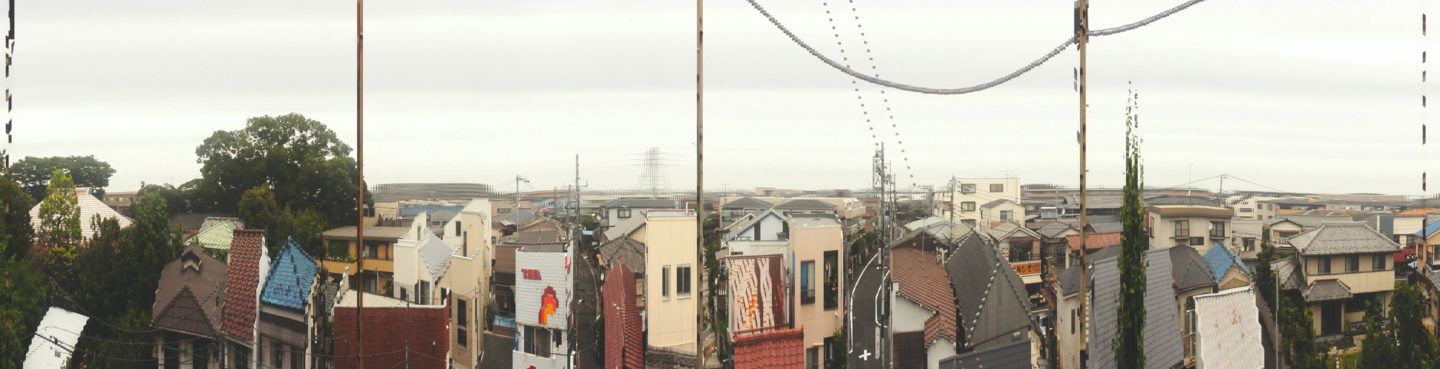
It also interesting that orthographic projection in horizontal and perspective projection in vertical mixed up in a single image.
Video artists, Páraic Mc Gloughlin and Hiroshi Kondo who I like also made videos with time displacement.
I was also inspired by Dirk Koy’s this video a lot especially from the beginning part that a car shrinks weirdly. Slit-scan with a low FPS footage causes a jaggy image, yet he turned the artifact into an interesting visual.
Inception style drone photography which used to be in fashion several years ago is also a sort of time displacement. Though some tutorials teach to combine 4 or 5 images from different angles somehow with Photoshop.
I would like to experiment with time displacement as it still has a lot of possibilities.
: